
TV reception
Do TV antenna boosters actually work?
Yes, TV antenna boosters work, but only when a good signal is getting weak on its way to your TVs. They can’t fix a poor signal at the antenna. In more than 25 years around Newcastle, Lake Macquarie, Port Stephens and the Hunter, Mark Jamieson has often found the real fix was moving the antenna or replacing a connector.
So test the signal before you buy anything. That’s the first step in every TV antenna job Mark does.
What does a TV antenna booster actually do?
A TV antenna booster makes the signal in your cable stronger. It’s an amplifier, and that’s all it is. It takes whatever arrives from the antenna and turns it up, the good parts and the bad parts alike.
Think of a scratchy recording. Turning up the volume makes it louder, but you can still hear the scratches, and now they’re louder too. A clean signal that’s just quiet benefits a lot from being turned up. A noisy one doesn’t.
You’ll come across two main types, and they do different jobs:
| Type | Where it goes | What it’s for |
|---|---|---|
| Masthead amplifier | On the mast, close to the antenna, powered through the cable by a small power supply indoors | Weak signal areas and long cable runs, boosting the signal before cable losses eat into it |
| Distribution amplifier | Indoors, usually in the roof space or near where the cable comes in | Sharing an already good signal between several TV points |
When a TV antenna booster is worth having
A booster is worth having when the signal at the antenna is clean, but there’s not enough left by the time it reaches the TV. These are the usual situations:
- A long cable run from the roof to the TV, as in a big or two-storey house
- Several TV points sharing one antenna, because every split weakens the signal
- A genuine low signal area, where a high gain antenna still needs help
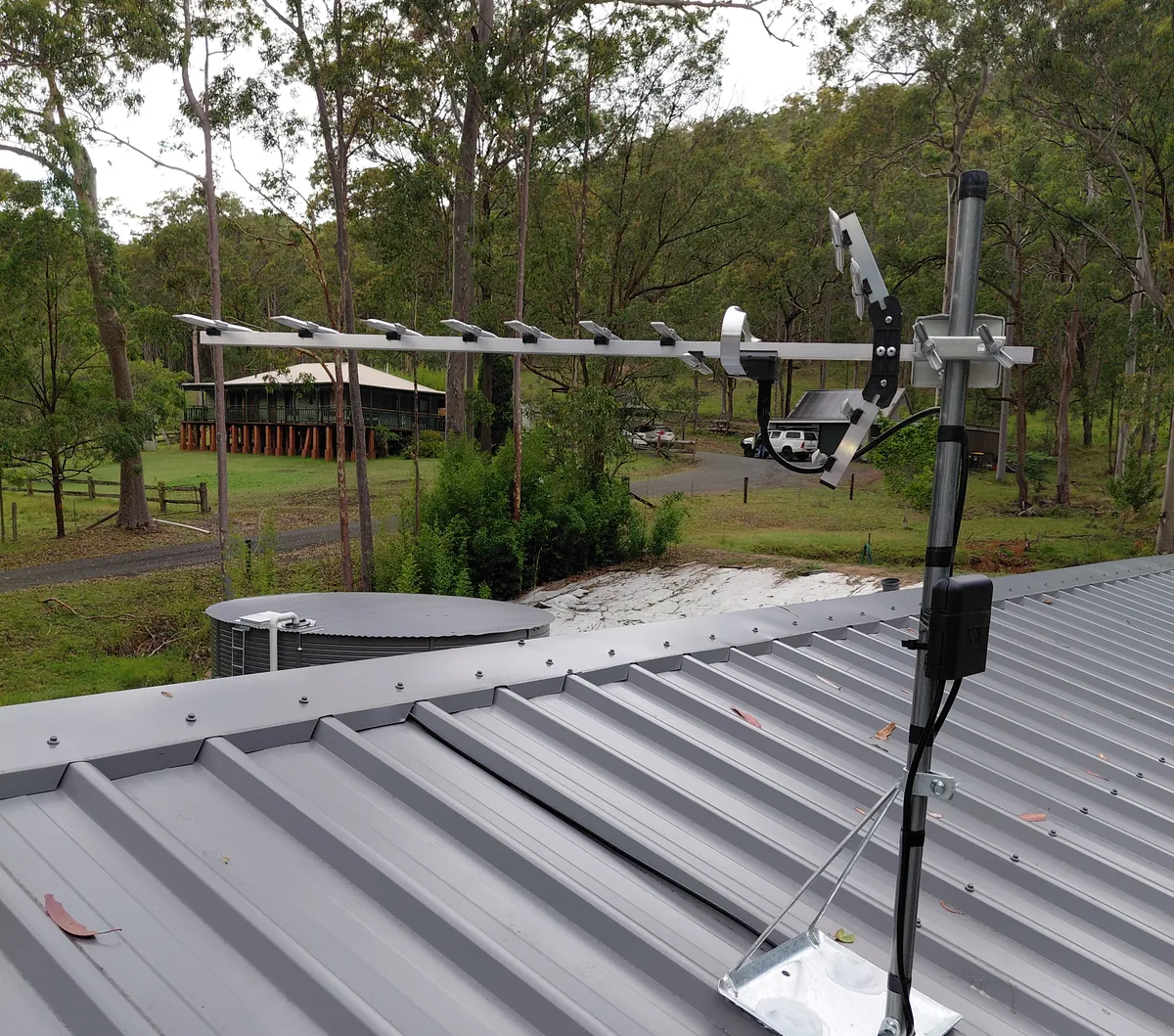
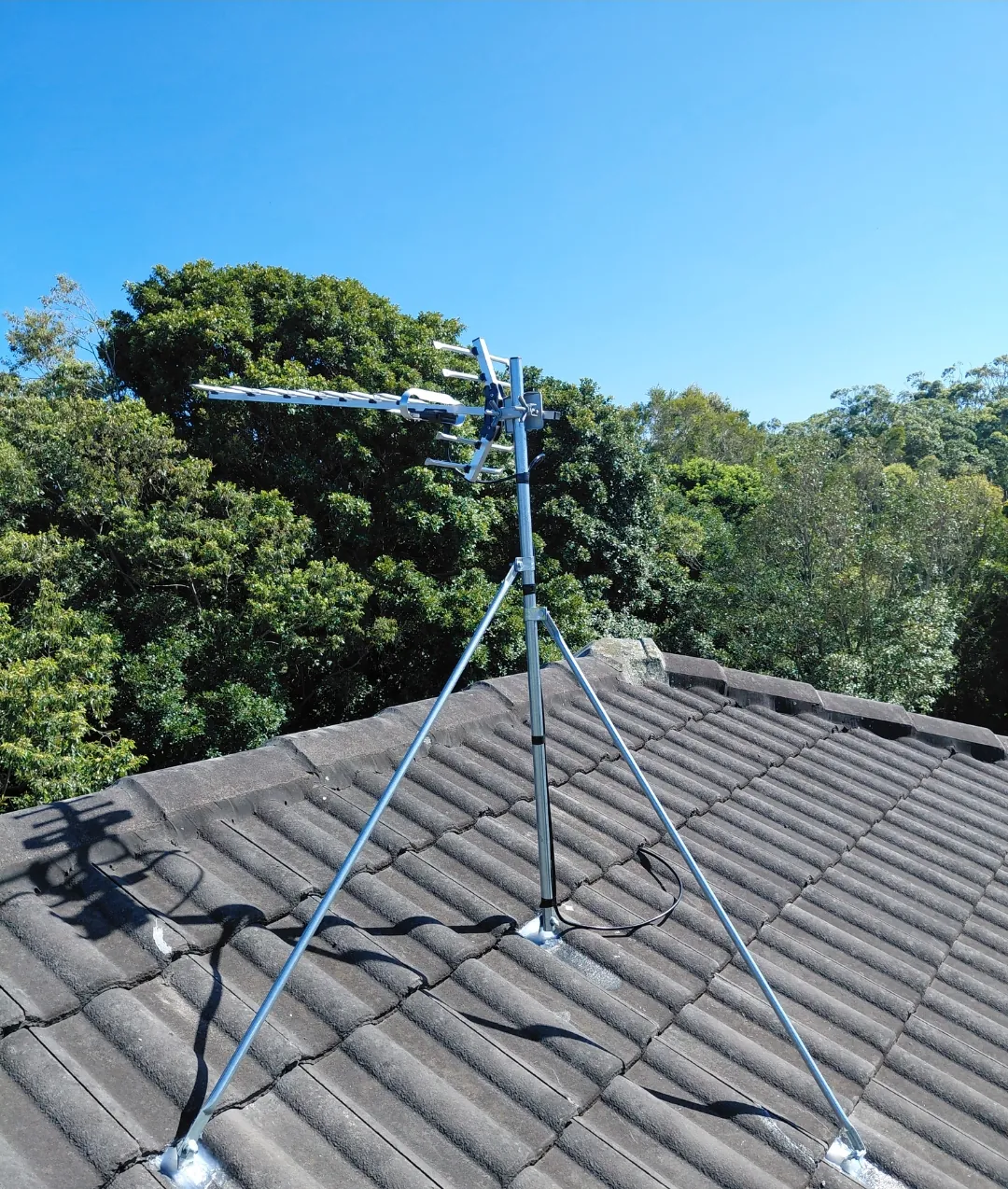
On one of Mark’s jobs at Eagleton, near Raymond Terrace, an area known for poor reception, he ran spectrum analysis to find the strongest spot on the roofline, mounted a high gain antenna on a braced mast, and then added a masthead amplifier. The booster was the last step, not the first. That order matters.
When a TV antenna booster won’t help
A booster won’t help if the problem is at the antenna or in the cable before it. That covers a lot of the jobs Mark gets called to:
- The antenna is in the wrong place. A hill, a tree or a neighbour’s new second storey is blocking the signal. Amplifying a blocked signal gets you a louder blocked signal.
- The antenna has been knocked out of line. Wind can twist it a few degrees off the transmitter. It needs re-aiming.
- Water has got into a connector. The signal fades at that point, so the fix is a new connector.
- There’s no signal at all. With nothing to amplify, a booster does nothing. That can mean a fault to fix, or a true black spot where VAST might be the answer.
This is why it’s worth a second opinion if someone has quoted you a booster without measuring anything. It’s common enough that Mark’s customers mention it in reviews: he’s been called in after a booster was quoted elsewhere, and found that moving the antenna was all it needed.
Can too much boost make TV reception worse? Yes
Too much signal is a problem as well as too little. A TV tuner works within a range, and if a strong amplifier pushes the signal past that range, the tuner overloads. The picture then pixelates or drops out, just as it does with a weak signal. Plenty of people have done this by adding a strong booster to a system that didn’t need one, then watched their reception get worse.
Near the transmitter, or wherever a signal is already healthy, an amplifier can cause more trouble than it solves. It’s also why “the strongest booster” is the wrong thing to shop for. What you want is the right level at each TV, and you can only get that by measuring it. An amplifier also boosts the 4G/5G mobile signals sitting just above the TV channels, one of the commonest causes of mobile tower interference on TV.
An old amplifier can also fail or start to misbehave, one of the commonest reasons for antenna repairs. If a masthead amplifier’s power supply dies, every TV loses signal at once and it looks just like a dead antenna. A faulty amplifier can even create interference. So if your system already has a booster and your reception has gone bad, it’s one of the first things to check.
Why are some signal boosters illegal in Australia?
The illegal ones are mobile phone boosters, not TV boosters. The two get mixed up because they share a name. The ACMA says mobile phone boosters are prohibited, with a maximum penalty of a $660,000 fine for owning or operating one. Mobile repeaters are treated differently, and you need written permission from a carrier to run one.
If your problem is poor mobile phone reception, don’t buy a cheap booster online. Talk to your carrier. A TV masthead or distribution amplifier is a separate device doing a separate job. Still, buy it from a reputable supplier, because a badly made one can interfere with other signals.
How to tell if you need a booster
The honest answer is a signal meter. It shows the strength and quality of each channel at the antenna and at each TV point, and that tells you exactly where the signal is being lost. Good quality with low strength at the far TVs points to a booster. Poor quality at the antenna points to a different fix.
Before you ring anyone, you can gather some clues yourself:
- Did it start suddenly? A booster is unlikely to be the answer. Look for something that changed or failed.
- Is one TV worse than the rest? Look at that TV’s cable first.
- Did you add TV points recently? The signal may now be split too many ways, and that’s where a distribution amplifier earns its keep.
As for what you’ll pay, it depends on what the test finds. Mark doesn’t use a price list. He quotes each job free, and for smaller jobs he can give you a rough idea over the phone.
Do TV antenna boosters actually work?
Yes, but only for the right problem. A booster works when you have a clean signal that gets weaker on its way to your TVs, usually through a long cable run or a split to several rooms. It won’t rescue a poor signal at the antenna, because it amplifies the noise along with the picture.
What is the strongest TV antenna booster?
The strongest isn’t the best. Too much gain can overload a TV’s tuner, and then the picture breaks up just as it does with too little signal. The right booster is the one that gets each TV into a healthy range, which you can only tell by measuring the signal.
Why is a signal booster illegal?
That’s about mobile phone boosters, not TV boosters. The ACMA says mobile phone boosters are prohibited in Australia, because they can interfere with mobile networks, and the maximum penalty for owning or operating one is a $660,000 fine. A TV masthead amplifier or distribution amplifier is a different device.
Do I need a booster for several TVs?
Sometimes. Each split in the cable weakens the signal, so a home with several TV points may need a distribution amplifier. If your signal is strong to begin with, a good splitter may be enough. Measuring the signal at the furthest TV point is how you find out.
Can a booster make my reception worse?
Yes. An amplifier that’s too strong for the signal can overload the tuner and cause pixelation, and it can pick up and boost interference. A faulty one can stop all your channels. If your problems started after one was fitted, have the signal levels checked.
What to do next
There are three sensible ways forward:
- Try the free checks first: go through the no-signal checklist. It takes about 5 minutes.
- Get the signal tested: ask Mark to test it, and if you don’t need a booster, he’ll tell you. Or ring him on 0408 563 949.
- Been quoted a booster already? Ask how the signal was measured. If it wasn’t, a second opinion is worth having.
About Mark Jamieson
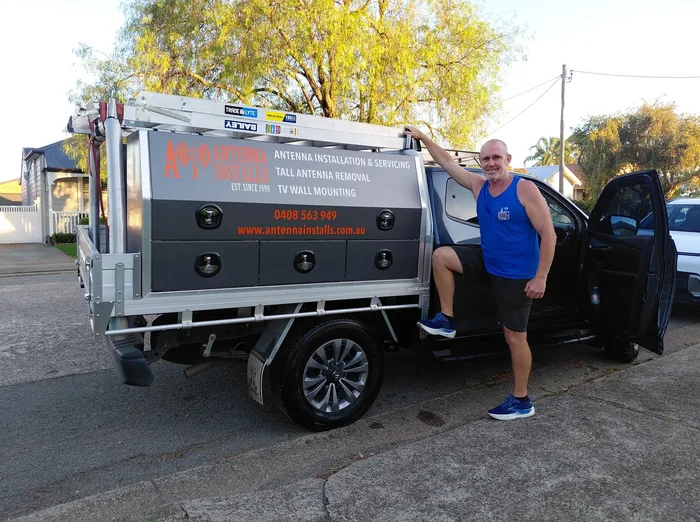
Mark runs Antenna Installs from New Lambton and has worked across Newcastle, Lake Macquarie and the Hunter since 1999. He is an electronic technician with an ACRS Registered Cable Licence (A019419), rated 5.0 from 565 Google reviews. More about Mark.

Free quote
Picture playing up? Call Mark.
No call-out fee, and quotes are free. Open 7 days. Smaller jobs priced over the phone, and often done on the spot.
0408 563 949