
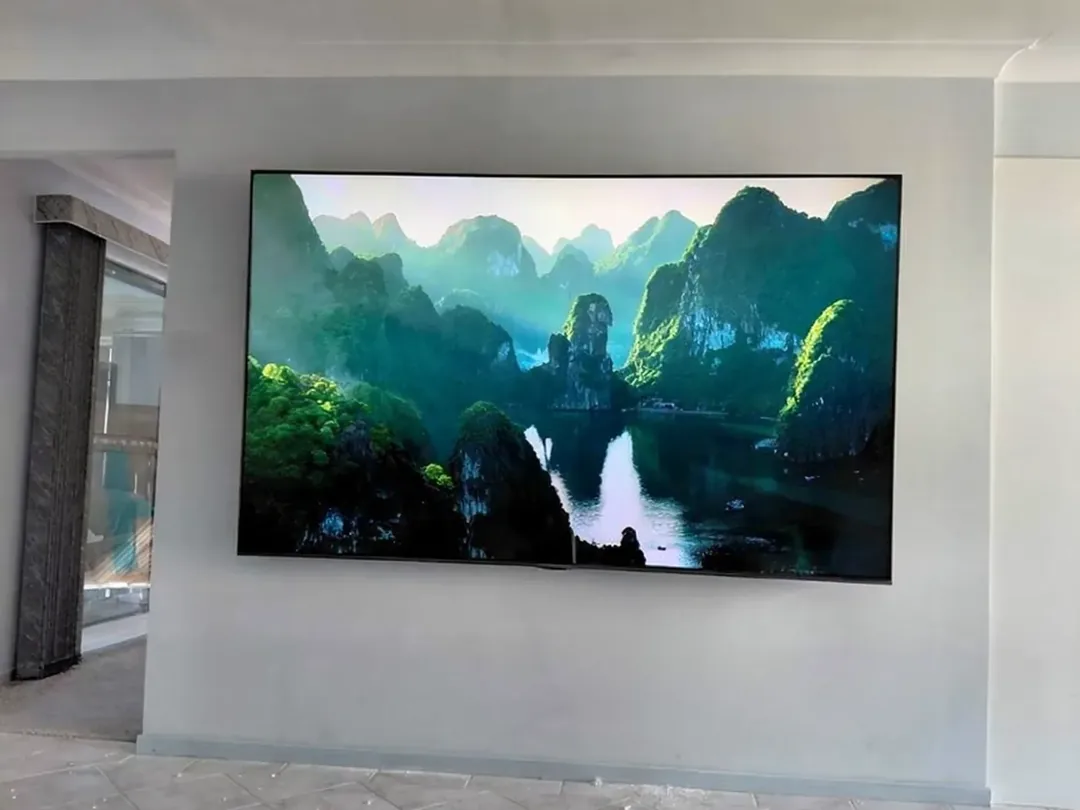
TV wall mounting
How high should you mount a TV?
Mount a TV so the middle of the screen sits at about eye level from where you usually sit. One mount guide puts that around 105 to 115 cm from the floor on a typical sofa, but measure yours, as it takes about 5 minutes and couches vary.
Mark Jamieson sets the height with you before he drills on every TV mounting job. Here’s how to work it out.
How high to mount a TV: the eye-level rule
The middle of the screen should line up with your eyes when you’re sitting down to watch. It’s the most common rule because it’s the most comfortable: you look straight ahead, and your neck stays neutral. Tom’s Guide makes a similar point, that the middle third of the screen is where most of your attention falls, so that’s the part to keep at eye level.
Another way to check it comes from SlashGear: the bottom edge of the screen roughly at seated eye level, and the top edge roughly at standing eye level. It tends to put the screen higher, which can suit a room where people watch while standing around, but it’s higher than most people want on a long movie.
On Mark’s old website, he put it simply: your TV should sit “at the right height for you.” A chart can’t do that. Two people on the same couch can have very different eye heights, and a low modern sofa can change the answer by 10 cm or more.
How to measure your TV height in 5 minutes
You only need a tape measure, some painter’s tape and another person.
- Sit where you watch. On the couch you actually use, slouched the way you actually sit.
- Measure your eye height. Have someone measure from the floor to your eyes.
- Mark the centre. Put a piece of tape on the wall at that height. That’s where the middle of the screen should go.
- Work out the bracket height. Half the TV’s height goes above your mark and half below. The bracket’s position depends on where it fixes to the back of your TV, so check that against the TV’s manual.
- Mock it up. Tape the TV’s outline on the wall, sit down and look at it for a few minutes. Walk around the room too. Masking tape is much easier to move than a bracket.
Does the size of the TV change the height?
The middle of the screen stays in the same place, but a bigger TV needs a bracket set differently, and the bottom edge sits closer to the floor. These are rough screen sizes, using the height of a standard 16:9 screen. Your own TV’s frame will add a little, so check its spec sheet.
| TV size | Screen height (approx.) | Bottom edge, if the centre is at 110 cm |
|---|---|---|
| 43-inch | 54 cm | About 83 cm from the floor |
| 55-inch | 68 cm | About 76 cm from the floor |
| 65-inch | 81 cm | About 70 cm from the floor |
| 75-inch | 93 cm | About 63 cm from the floor |
| 85-inch | 106 cm | About 57 cm from the floor |
| 100-inch | 125 cm | About 48 cm from the floor |
That last row is worth a look. On a 100-inch TV, the eye-level rule leaves less than 50 cm under the screen, so a cabinet or a soundbar setup might not fit. With very large screens, people often raise the centre slightly so there’s room underneath, and sit further back to make up for it.
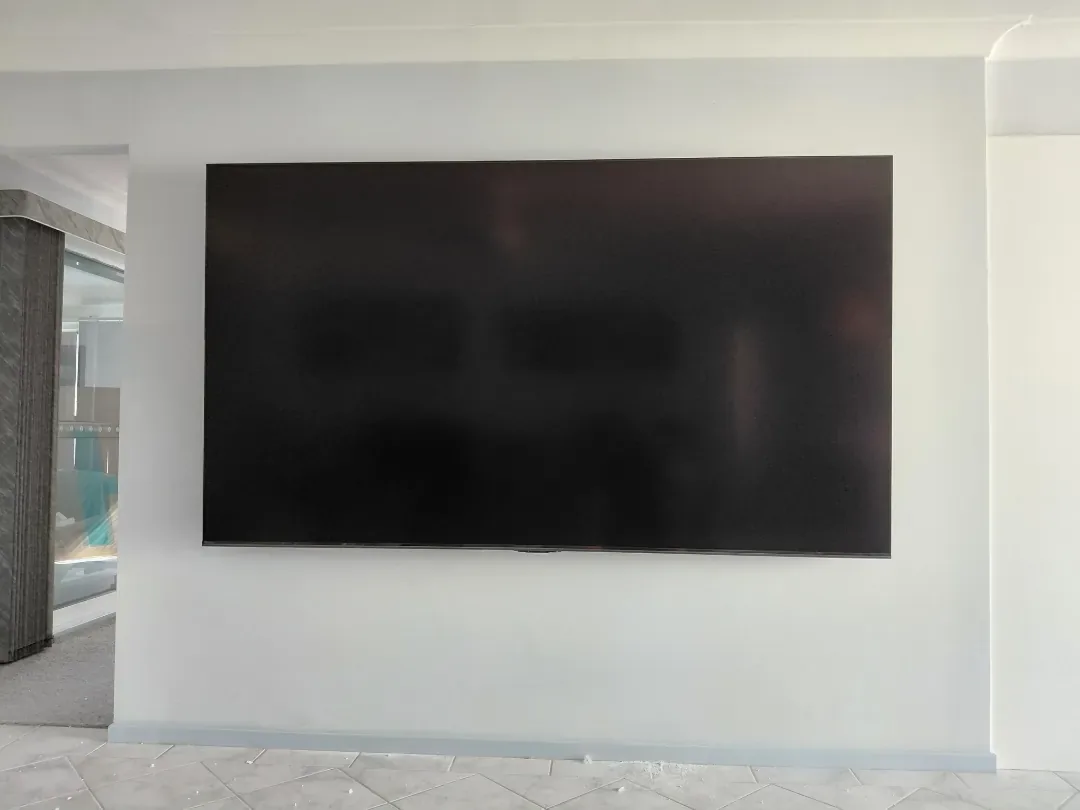
TV height in bedrooms, kitchens and outdoor areas
Bedrooms. You usually watch from propped-up pillows, so your eyes are higher than you’d think. Measure from the bed. A tilting bracket lets the screen angle down towards you, and Bob Vila’s guide points to tilting as the usual fix when a TV has to sit higher than ideal.
Kitchens and bars. People tend to be standing, or on high stools. Measure from where they’ll be, and go higher to suit.
Outdoor areas and patios. Watch for glare and sun at different times of day, and think about the bracket and connections in the weather. A patio in Merewether or Caves Beach also gets salt air, so everything needs to suit the outdoors.
Above a fireplace. It’s the classic trouble spot. The screen ends up far above eye level, and heat can be a problem if you use the fire. If it’s the only wall that works, a tilting or pull-down bracket helps, but it’s worth thinking about another wall first.
Will your wall hold the TV at that height?
The right height is no use if the wall can’t take it there. On plasterboard, the fixings have to go into the frame. Australian studs are often 450 or 600 mm apart, and the bracket has to reach them, which may not line up with where you want the TV. That can shift the screen sideways, so check before you settle on a spot.
Steel frames and brick need different fixings again. There’s more on that, and on getting cables out of sight, in how to hide TV cables in the wall.
When not to mount a TV on the wall
A wall mount isn’t always the answer. Here are a few times when a good cabinet may be the better choice:
- You rent and can’t get permission to drill
- The only spot gets direct sun at the time you watch
- The only spot is high over a fireplace you use
- The wall is damaged or crumbling, or you can’t find anything solid to fix to
What height should a wall-mounted TV be at?
Put the middle of the screen at about eye level from where you sit. One mount guide puts a typical sofa’s seated eye level at about 105 to 115 cm from the floor, but your couch may be different, so measure yours. If you often watch from a recliner or a bed, measure from there instead.
When should you not mount a TV?
Think twice if the wall can’t hold it, if it means putting the TV high over a fireplace you use, or if the screen would get direct sun. Also, if you rent and can’t get permission, or the room may change soon. A TV on a good cabinet is better than one badly mounted.
Can drywall hold a 65-inch TV?
Not by itself. Plasterboard won’t hold a TV, whatever anchors you use. A 65-inch TV must be fixed into the frame behind it, using a bracket rated for the weight. In Australia, studs are often 450 or 600 mm apart, so check that your bracket can reach two of them.
Should a TV go lower or higher in a bedroom?
Usually higher, because you’re often watching from propped-up pillows. Sit the way you normally watch and measure your eye height from there. A tilting bracket helps, as it lets you angle the screen down towards the bed when it has to sit higher.
How high should a TV go above a soundbar?
Leave enough room for the soundbar to fit under the screen with a small gap, so the bar doesn’t block the TV’s sensor and the sound isn’t muffled. Use the same eye-level rule for the screen first, then fit the soundbar into the space below it. Mark mounts soundbars as part of a home theatre install.
What to do next
- Got your height? Mark it with tape and leave it for a day. If it still feels right, you’re ready.
- Want it done for you? Message Mark with the TV size and wall type for a rough idea. Or ring him on 0408 563 949.
- Hiding the cables too? Read how to hide TV cables in the wall first.

About Mark Jamieson
Mark runs Antenna Installs from New Lambton and has worked across Newcastle, Lake Macquarie and the Hunter since 1999. He is an electronic technician with an ACRS Registered Cable Licence (A019419), rated 5.0 from 565 Google reviews. More about Mark.

Free quote
Picture playing up? Call Mark.
No call-out fee, and quotes are free. Open 7 days. Smaller jobs priced over the phone, and often done on the spot.
0408 563 949